PRODUCT
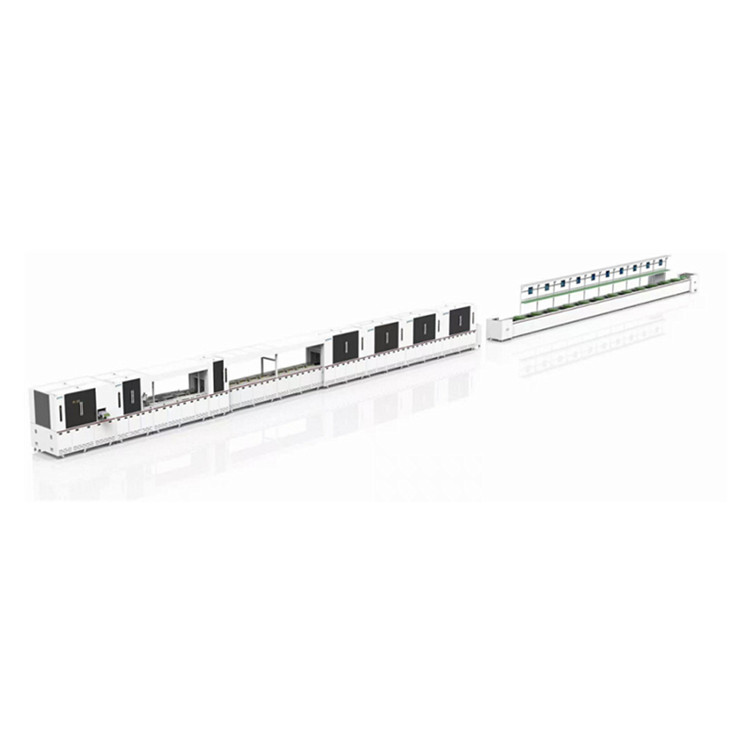
Cylindrical Lithium Battery Pack Full Automatic Assembly Production Line China
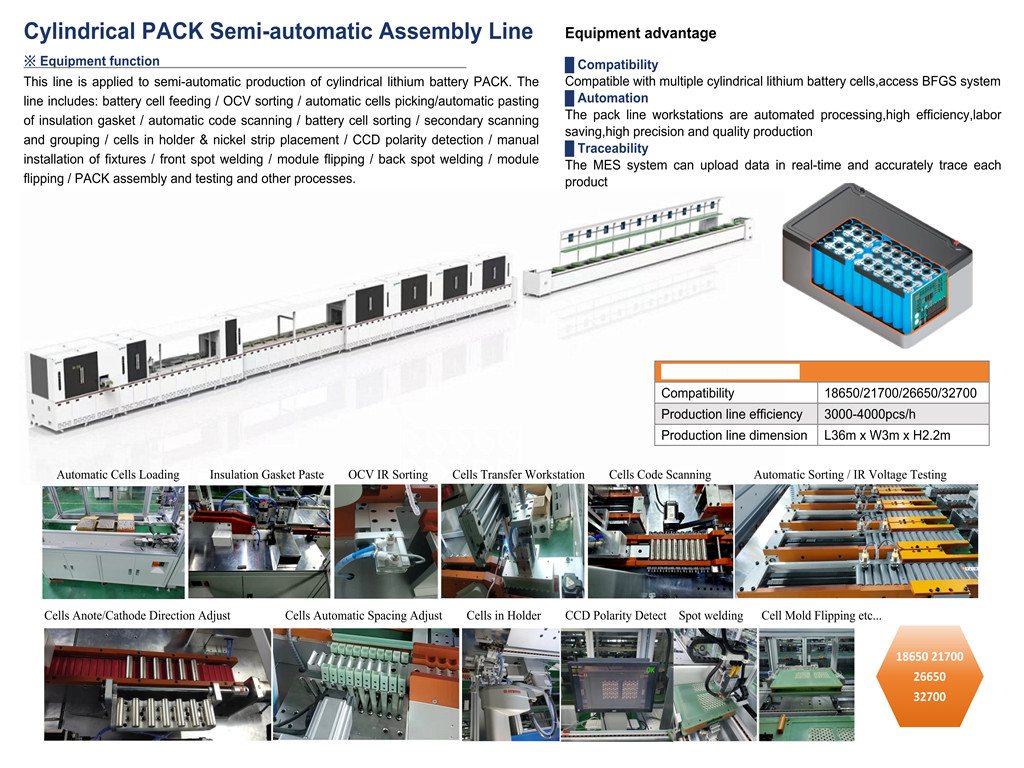
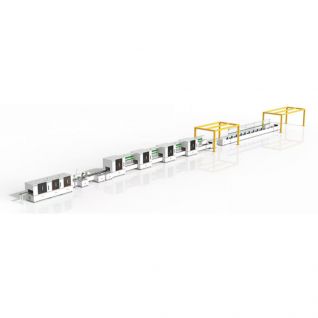
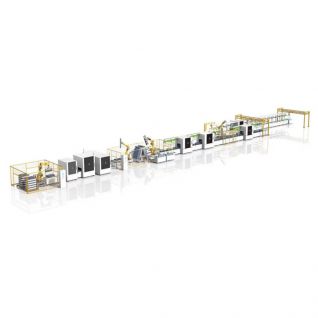
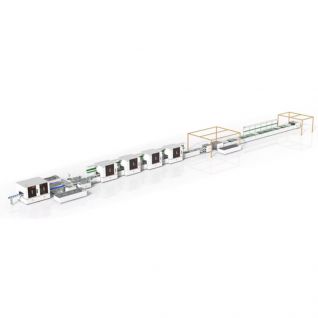
An automatic assembly line for cylindrical battery packs is a highly automated production system specifically designed to mass-assemble individual cylindrical cells (such as common specifications like 18650, 21700, and 26650) into battery packs with specific voltage and capacity (also referred to as "battery modules").
Automatic Assembly Line for Cylindrical Battery Packs
An automatic assembly line for cylindrical battery packs is a highly automated production system specifically designed to mass-assemble individual cylindrical cells (such as common specifications like 18650, 21700, and 26650) into battery packs with specific voltage and capacity (also referred to as "battery modules"). By integrating mechanical automation equipment, sensors, control systems, and software algorithms, it enables a fully or semi-automated process from cell loading to the final completion of battery packs.
Core Functions and Workflow
The assembly of cylindrical battery packs involves multiple key steps, and the automatic assembly line sequentially completes the following processes through modular equipment (specific workflows may vary slightly based on battery pack specifications):
Cell Loading and Screening: Automated loading mechanisms (e.g., vibratory feeders, robotic arms) transport cells from bins to the production line. Simultaneously, visual inspection or parameter testing equipment (such as voltage and internal resistance testers) screen out defective cells (e.g., those with leakage or abnormal internal resistance) to ensure the consistency of raw materials.
Cell Arrangement and Positioning: Qualified cells are neatly arranged (e.g., grouped or aligned) according to preset quantities (based on series/parallel requirements) and fixed in position using jigs to prepare for subsequent welding.
Tab/Electrode Welding: Automated welding equipment (such as laser welding or ultrasonic welding) connects the positive and negative tabs (or electrodes) of cells to connecting sheets (e.g., nickel sheets, copper sheets), establishing electrical connections between cells (series connections increase voltage, while parallel connections increase capacity).
Insulation and Fixation: After welding, automated equipment wraps insulating materials (e.g., insulating paper, insulating film) and secures the cell assembly using adhesive tape, brackets, or potting to prevent short circuits or structural loosening.
Inspection and Testing: The assembled battery packs undergo multi-dimensional testing, including total voltage, internal resistance, insulation performance, and appearance defects (e.g., cold solder joints, missing solder joints). Unqualified products are automatically rejected.
Packaging and Unloading: Qualified battery packs are finalized through automated packaging equipment (e.g., casing, labeling) and then transported to the finished product warehouse via conveyor systems.
Core Components
Automated Equipment Modules: Include loading machines, screening machines, arranging machines, welding robots, insulating machines, testing equipment, and packaging machines, each responsible for specific processes.
Conveying and Positioning Systems: Such as conveyor belts, robotic arms, and servo motor-driven jigs, ensuring precise transfer of cells/battery packs between modules.
Control Systems: Centered on PLCs (Programmable Logic Controllers), combined with sensors (visual, pressure, displacement, etc.) and HMIs (Human-Machine Interfaces), enabling equipment linkage, parameter adjustment, and fault alarms.
Software Systems: Used for production data collection, process monitoring, and quality traceability (e.g., MES systems), supporting production efficiency optimization and quality control.
Advantages
Efficient Mass Production: Compared to manual assembly, automated lines can process several cells per second, with a daily output of tens of thousands to hundreds of thousands of packs, meeting large-scale production needs (e.g., new energy vehicles, energy storage batteries).
Stable Quality: Controlled by precision machinery and sensors, it reduces errors from manual operations (e.g., uneven welding strength, alignment deviations), improving the consistency and safety of battery packs.
Cost Reduction and Efficiency Improvement: Lowers labor costs, reduces material waste caused by human error, and optimizes production rhythms through data-driven management.
High Safety: Isolates cells (which may pose electrolyte or high-voltage risks) via automated equipment, reducing the probability of human exposure to hazards.
Application Scenarios
Widely used in power battery packs for new energy vehicles, battery packs for energy storage stations, batteries for power tools, and batteries for smart home devices (e.g., floor-cleaning robots). It is a core production equipment for large-scale applications of cylindrical cells.